Time to Get Plastics Out of Kids Clothes

This just in from BeyondPlastics.org:


Spread the word about these companies’ plastic clothing to more people and build momentum for change.

Sign the petition to urge children’s clothing makers to reduce their polyester footprint. here

Here’s their message that arrived today from their email to me as a subscriber:

“Did you know that most clothing is made of plastic? In fact, polyester is now the most widely produced fiber in the world, accounting for more than half of all global fiber production.1

This is a particular concern for the youngest members of society. 👶👶🏾 Babies and kids are more vulnerable to the toxic chemicals used in plastics than adults because their brains and organs are still developing, they receive a higher dosage due to their smaller body size, and they tend to put their hands and clothing in their mouths often.2 😨

That’s why we’re working to protect children’s health by calling on three top children’s clothing-makers to stop using so much toxic plastic in their products. 🛑 Will you please join us by signing our petition to these brands? ✍️
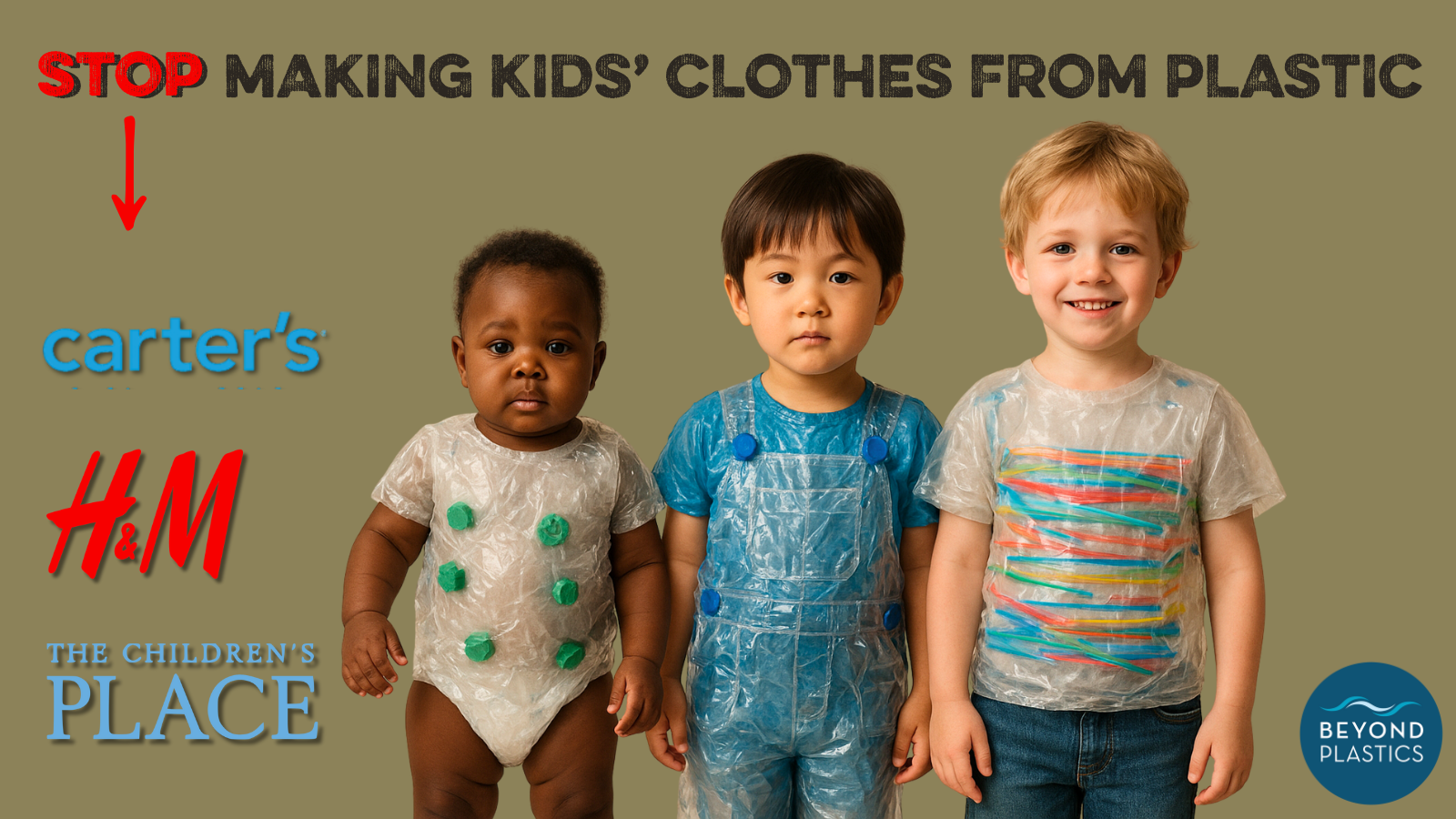
Unfortunately, more and more clothing is made out of polyester—a form of plastic made from fossil fuels and synthetic chemicals that includes many chemicals of concern. ☣️👕👖👚

Defenders of Health’s 2025 Children’s Fashion Scorecard found that many of the chemicals used in polyester — including phthalates, bisphenols, and flame retardants—are known “endocrine disrupters”3 that interfere with the body’s hormonal system, which is essential to a child’s development. Studies have found that exposure to endocrine disrupters, even at low levels, can have long-lasting consequences in children.4

Add Your Name: Stop Making Kids’ Clothes from Plastic📣

On the bright side, there are safer fibers available to clothing-makers, including cotton, linen, wool, and hemp. ✅ And, just as they control the style and fit of the clothes they manufacture, clothing companies can also choose to cut down on polyester and other synthetic fabric in their products.

Please join us in urging leading children’s clothing makers Carter’s, H&M, and The Children’s Place to stop using so much of this plastic in their products. Add your name to the petition here.

  • In 2024, H&M reported that polyester makes up 22% of its clothing, with other synthetic fabrics including acrylic, elastane, and cellulosic fiber fabrics like viscose, modal, and lyocell accounting for an additional 12 to 22% of its products.5
  • In 2024, Carter’s reported that polyester makes up 28% of its clothing, with the synthetic fabrics viscose and elastane accounting for an additional 2.8% of its products.6
  • In 2022, The Children’s Place reported that polyester makes up 17.9% of its clothing, with the synthetic fabrics modal, viscose, nylon, elastane and acrylic accounting for an additional 2.6% of its products.7

That’s a whole LOT of plastic. 🆘

We believe that all babies and children deserve to wear safe, non-toxic clothing that will not threaten their health or harm the environment.

Please join Beyond Plastics and our allies at Defend Our Health in urging these companies to commit to reducing their polyester footprint and providing more transparency about the chemicals used in their clothing. Click the button below to add your name to the petition. ⬇️

Stop Making Plastic Kids’ Clothes

Then please spread the word to reach more people and build momentum for these companies to act.

Thank you for your help.

Cheers,

Judith Enck
President, Beyond Plastics
Former US EPA regional administrator”
Judith Enck

Donate to fight plastic pollution


References:

1. https://textileexchange.org/app/uploads/2024/09/Materials-Market-Report-2024.pdf
2. https://www.oecd.org/en/publications/estimating-mouthing-exposure-in-children-compilation-of-case-studies_debe99f0-en.html
3. https://www.endocrine.org/-/media/endocrine/files/advocacy/edc-report2024finalcompressed.pdf
4. https://defendourhealth.org/wp-content/uploads/2025/06/Fashion-Scorecard-Report-2025.pdf
5. https://hmgroup.com/wp-content/uploads/2025/03/HM-Group-Sustainability-progress-report-2024.pdf
6. https://cdn.bfldr.com/7AQFZOE0/at/3z75gg9c6jxxrqnmm7vsksqf/2024_RTF_Impact_Report.pdf
7. https://corporate.childrensplace.com/static/TCP-2022-ESG-Report-Final-85d3db4e7e0d6e97bdfd2425839573c5.pdf
Surprising Data on 5 Exercises for Seniors

Here’s a link to a YouTube video about 5 exercises clinically superior to long walks. These are no substitute for cardio IMO and I will continue to do fast walking on my treadmill. However, I’ve been adding planks, several yoga poses, and some resistance work every other day. After viewing this video and learning about the studies behind it, I’m likely to incorporate some, if not all, of these exercises in my routine because it’s hard to argue with the clinical results. Here’s the link:

https://youtu.be/Ado6dItMebE?si=uPl8bq8c9K8YelzW

A big Thank You to the author for these amazing data. You’ll probably be surprised as I was. Cheers!

Tell Your U.S. House of Representatives to Support the Microplastics Safety Act Today

This came in today from Environment America:

It’s bad enough that researchers keep finding plastic trash blocking the digestive tracts of dolphins. Or “shocking” levels of smaller plastic particles, known as microplastics, in sea turtles.1Now scientists are finding microplastics in people too, and they’re growing increasingly concerned about the impacts on our health.That’s why we’re urging the U.S. House of Representatives to pass the Microplastics Safety Act, which would require the Food and Drug Administration (FDA) to study the impacts of microplastic exposure on human health.2Add your name. Tell your U.S. House representative to support the Microplastics Safety Act today.Research suggests microplastics in people could lead to inflammation, lung and liver effects, and a disturbing list of other health problems. But the researchers need to do more. And given increasing plastic and pollution, we can’t wait long for the answers.Just as a turtle doesn’t know that it’s eating a plastic bag instead of a jellyfish, most of us don’t know that we’re ingesting plastic dust from plastic-wrapped tomatoes and peppers, plastic water bottles or even the air we breathe.3 Nor do we know what all this plastic is doing to our health. We’re guinea pigs in a massive science experiment that nobody authorized.Researchers have found links between microplastic consumption and health issues ranging from inflammation to rising rates of cancer and more.4,5 But they need to do much more research to determine how strong these links are — and how worried we should be.The Microplastic Safety Act would help fill this knowledge gap by directing the FDA to conduct a comprehensive study of the impacts of microplastics on our health. And this bill has something rare in Congress these days: bipartisan support.Will you tell your U.S. House representative to help protect our health from microplastics?The Microplastics Safety Act wont stop the flow of plastic waste and pollution into our environment and our bodies. But it could result in powerful new evidence for why we must stop this pollution — not only to save sea turtles and dolphins, but people, too.Congress has an opportunity to take a step in the right direction to help us all better understand how microplastics affect human health. Ignoring the threat of microplastics to our health is unacceptable.Urge your U.S. House representative to support the Microplastics Safety Act today.Thank you,Lisa Frank
Executive Director

1. Rob Hutchins, “‘Shocking’ levels of microplastics found in sea turtle organs,” Oceanographic, January 4, 2025.
2. “Bynum introduces legislation to examine the impacts of microplastics,” Office of Congresswoman Janelle Bynum, July 17, 2025.
3. Grace Vickers, “Studies show how microplastics from packaging get into our food,” PIRG, July 21, 2025.
4. Nina Agrawal, “What Experts Want You to Know About Microplastics,” The New York Times, May 20, 2025.
5. Beth Dougherty, “Microplastics and Cancer: Your Questions Answered,” Dana-Farber Cancer Institute, March 7, 2025.

Environment America, Inc.
1543 Wazee Street, Suite 410, Denver, CO 80202, (303) 801-0581
Member Questions or Requests: 1-800-401-6511
Facebook | Twitter | Instagram

Keep the Faith, Hope, and Embrace Non-Violent Action!!!

These are indeed dark and deeply disturbing days we’re having to witness. Faith and hope are always welcome allies, but we’ll also need non-violent action in the days to come to stem the tide of brutality and injustice that’s being foisted upon the people by the current administration.  There isn’t room here to iterate the wrongs being committed.

FWIW (For What It’s Worth) I have found a great source of comfort in reading the many wonderful articles to be found in Substack.com. It’s more than people ranting and raving about what we’re up against. There are also writings that bring comfort, inspiration, and perspective. One among many is Dino Alonso. This website/application is a truly excellent model – it doesn’t cost a dime to subscribe. If/when you find an author, or you yourself wish to contribute as one, you will find a host that is more interested in disseminating ideas than making money. Blessings on you and yours!

Indivisible And Partners Announce ‘NO KINGS’ Nationwide Day of Defiance on Flag Day, During Trump’s Birthday Parade

That’s Saturday June 14th. Check your local Indivisible chapter for exact time, but they’re usually at Noon. This administration is actually openly proposing doing away with Habeas Corpus, better known as “Innocent until proven guilty”, a cornerstone of this democracy. This is in addition to doing away with “Due Process” and the constitution. Who’s next? Silence is NOT an option!

Join a Nationwide Protest on April 5th

Until this evening, I was unfamiliar with the website wardrobeoxygen.com, but they’ve done a splendid job of laying out the various groups that are organizing and why they’re doing so. We’re at a pivotal time in our nation’s history and this is not the time to sit on the sidelines. Please check out this website if you care about what’s going on in the United States today and want to understand the scope of this event: https://www.wardrobeoxygen.com/details-on-the-april-5th-national-day-of-protest/ .

A Filter for Microplastics?

Some great news for a change! According to ethicalmarkets.com, China has discovered a filter made from cotton and squid bone (hopefully they can find a replacement for the poor squid soon) that’s having success filtering these microplastic bad boys! Check out their article: https://www.ethicalmarkets.com/cotton-and-squid-bone-sponge-can-soak-up-99-9-of-microplastics-scientists-say/