Dino Alonso in Substack brings us focus on what’s happened in Minneapolis and elsewhere…

Dino is one of the more inspiring and thoughtful authors in Substack. He wrote the following today:

“I’ve been up much of the night and this morning, calling my friends and associates. We’re all in agreement this isn’t a sensational headline or another political football, but that it’s an actual existential boundary crossed in full daylight.

I spent more than two decades inside the immigration system. As I mentioned in a previous response, I worked closely enough with ICE to know the difference between enforcement and domination. What happened here isn’t the hard edge of law doing difficult work. It’s restraint giving way, followed by a rush to explain force after the fact. Those are not the same thing, and anyone who’s worked inside institutions knows how dangerous that substitution is.

Renee Nicole Good’s death is first a human catastrophe. Three children lost their mother in minutes. A family shattered on a residential street. That alone should stop us. But it’s also something else. It’s a legitimacy test.

Legitimacy doesn’t come from uniforms, jurisdiction, or the seal on a press release. It comes from consent, restraint, and accountability. When armed agents kill an unarmed civilian, block medical aid, fabricate a public narrative, and walk away unnamed and untouched, legitimacy doesn’t wobble. It drains out.

This is how institutional rot actually looks. Not as chaos, but as procedure losing its moral anchor. Training shortened. Oversight treated as friction. Speed rewarded. Narrative management replacing truth. Force moving faster than accountability, then daring the rest of us to catch up.

I’ve watched institutions lose their bearings before. It almost never starts with cruelty declared. It starts with language changing. People stop saying, “We need to be careful,” and start saying, “We need to move.” Explanation gives way to assertion. Death becomes a communications problem instead of a moral rupture.

That shift matters more than any single incident, because it carries forward. What’s normalized becomes practice. What’s excused becomes precedent. What goes unchallenged becomes inheritance. Systems trained to act this way don’t self correct. They teach the behavior downward and outward until restraint feels optional and violence feels administrative.

That’s why this moment can’t be absorbed quietly.

A republic doesn’t survive on good intentions or internal assurances. It survives on boundaries that hold even when they slow things down. Especially then. If those boundaries fail here, in public, on a city street, the loss isn’t abstract. It’s civic. It’s moral. It belongs to all of us.

This isn’t about vengeance. It’s about refusing a future where power explains itself only after blood has been spilled, and even then, badly. Accountability isn’t hysteria. It’s the price of legitimacy.

If we can’t say that plainly now, then we’re not preserving order.

We’re surrendering it.”
Some potentially GREAT news about a bacteria that eats plastic!!

Funny how I didn’t see this on any of the major news networks. Here’s the link to the story found on the goodnewsnetwork.org: https://www.goodnewsnetwork.org/scientists-engineered-a-bacteria-to-eat-plastic-bottles-and-transforming-them-into-useful-liquids/. We can only hope and pray that this research continues and can be made scalable. While we still think that reducing our production of plastics needs to happen, this brings new hope to an otherwise troubling future with plastics.

Good News!

It can sometimes be a struggle to hear and see all the violent images and bad news in today’s world. In fact, one of the topics in our men’s group meetings was “How do you cope with the constant barrage of depressing and deeply disturbing information routinely disseminated in almost every newscast or news article.” One answer was to limit your exposure to such news/broadcasts, be they TV, radio, phone applications, etc. Unplugging ourselves periodically from our electronic and media saturated world is now considered a VERY healthy practice. Happily, there are alternative news sources that can uplift us instead of dragging us down and depressing us. These are two of my favorites:

https://www.positive.news

It’s like a tonic or an ice-cold drink on a hot day. Your psyche and soul will thank you for bringing a bit of joy and optimism to your day. There IS good happening out there – it’s just not as dramatic and, for many, as alluring as the bad news. Some might argue that bad news sells copy more than good news but how can we know that since the ratio of bad to good news is nothing short of staggering?

Goodnews (the application)

This wonderful journalistic collection is available on Android (what I use) and I suspect is also available on iPhones as well. The application comes to us from Germany but is available in English. I did a search just now on Microsoft Store for Goodnews and I didn’t see this application there. If you know of others, please pass them along. I suspect we can always use a bit more joy in our lives.

What we can do about Plastics

Worthy visions are all well and good, but without planning and doing, that vision has little chance of materializing. In the Men’s Group I attend weekly, our organizer posed this question to us as a topic teaser: “What has to happen before…?” In the case of plastics, MANY things need to happen before we can even begin to see a light at the end of the plastics tunnel. Here’s just a few:

1) Taxes need to be levied on plastics – see H.R. 5389, the “Reduce Act” presently sitting in Congress – we need to tell our U.S. Representative we expect them to support it (in this case, our Olympic Peninsula WA Representative. Derek Kilmer already does, thank the Gods, but we should also write the others!). 
2) We would do well to start making building blocks/material/consumer products from plastics that are tossed and giving tax breaks to those organizations that do so.  Additionally, they have to be reused in a SAFE manner.  Here’s just a few of these already happening: 
https://www.intheknow.com/post/innovative-building-blocks-are-made-of-100-percent-plastic-waste/
Also https://www.weforum.org/agenda/2021/10/phillipines-company-turning-plastic-waste-into-building-materials/   
Also https://www.wwf.org.au/news/blogs/17-cool-products-made-from-recycled-plastics

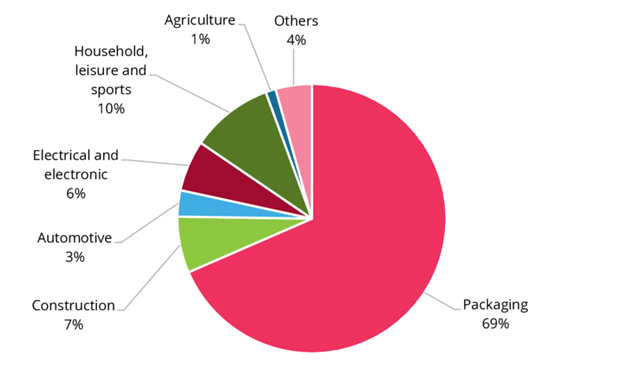
It goes without saying that we need to find and purchase food that is packaged to minimize the use of plastics. The following chart from the above link to weforum.org underscores this big time:

The above pie chart of estimated plastic waste by industrial sector was prepared by Ed Cook, Emma Burlow, Edward Kosior, Bernie Thomas, Brian Riise and John Gysbers in article “Eliminating avoidable plastic waste by 2042: a use-based approach to decision and policy making.” and presented by “Resourcing the Future Partnership Steering Group”. The article was published in collaboration with Reuters 27 Oct 2021 by Adrian PortugalJournalist, Reuters.

What we can do about Plastics

Worthy visions are all well and good, but without planning and doing, that vision has little chance of materializing. In the Men’s Group I attend weekly, our organizer posed this question to us as a topic teaser: “What has to happen before…?” In the case of plastics, MANY things need to happen before we can even begin to see a light at the end of the plastics tunnel. Here’s just a few:

1) Taxes need to be levied on plastics – see H.R. 5389, the “Reduce Act” presently sitting in Congress – we need to tell our U.S. Representative we expect them to support it (in this case, our Olympic Peninsula WA Representative. Derek Kilmer already does, thank the Gods, but we should also write the others!). 
2) We would do well to start making building blocks/material/consumer products from plastics that are tossed and giving tax breaks to those organizations that do so.  Additionally, they have to be reused in a SAFE manner.  Here’s just a few of these already happening: 
https://www.intheknow.com/post/innovative-building-blocks-are-made-of-100-percent-plastic-waste/
Also https://www.weforum.org/agenda/2021/10/phillipines-company-turning-plastic-waste-into-building-materials/   
Also https://www.wwf.org.au/news/blogs/17-cool-products-made-from-recycled-plastics

It goes without saying that we need to find and purchase food that is packaged to minimize the use of plastics. The following chart from the above link to weforum.org underscores this big time:

The above pie chart of estimated plastic waste by industrial sector was prepared by Ed Cook, Emma Burlow, Edward Kosior, Bernie Thomas, Brian Riise and John Gysbers in article “Eliminating avoidable plastic waste by 2042: a use-based approach to decision and policy making.” and presented by “Resourcing the Future Partnership Steering Group”. The article was published in collaboration with Reuters 27 Oct 2021 by Adrian PortugalJournalist, Reuters.