
This article comes to us from truthout.org on October 7th, 2022 in an article written by Tina Casey. According to Tina, “Global plastic waste is expected to triple by 2060 as fossil fuel stakeholders pursue new revenue in petrochemicals.” Here’s the link.
Author: Brian Berardo
Check out bberardo.com for details.
In case you haven’t watched “Eating Our Way To Extinction”
This can still be viewed for free on YouTube and I believe it’s also available on Prime Video. While it may have a depressive effect, it does a good job of driving home the impact of our eating habits on our planet. Then this morning I found the following article on one of my newsfeeds. It seems wells are running dry in drought-weary Southwest as foreign-owned farms guzzle water to feed cattle overseas:
https://www.cnn.com/2022/11/05/us/arizona-water-foreign-owned-farms-climate/index.html
I had just finished an article for our UU weekly bulletin “Making Healthy Food Choices” in which I extolled the virtues of vegetarian and vegan diets and how they’re good for our bodies, the animals, and the planet. However, for those that struggle with these diets, we are blessed to have reducetarian.org reminding us that you don’t have to be a strict anything. They remind us that any reduction in eating meat helps move us in the right direction and away from the torture of factory farmed animals. My wife and I still eat meat occasionally, but we make sure that the meat is sourced from farms that are dedicated to grass-fed/grass-finished, pastured raised, and humanely raised animals. That’s the least we can do.
And Four to Go…
This is the follow-up to “One for the Money”, “Two for the Show”, “Three to get Ready”, and, as this saying goes, “And Four to Go”. I thought I had already posted this but couldn’t find it on the website and it begs to be read:
“All We Can Save: Truth, Courage, and Solutions for the Climate Crisis was written by no less than dozens of diverse women leading on climate in the United States – scientists, journalists, farmers, lawyers, teachers, activists, innovators, wonks, and designers, across generations, geographies, and race – and aims to advance a more representative, nuanced, and solution-oriented public conversation on the climate crisis.”[1]
“…Intermixing essays with poetry and art, this book is both a balm and guide for knowing and holding what has been done to the world, while bolstering our resolve never to give up on one another or our collective future. We must summon truth, courage, and solutions to turn away from the brink and toward life-giving possibility. Curated by two climate leaders, the book is a collection and celebration of visionaries who are leading us on a path toward all we can save.”[2]
[1] Ayana Elizabeth Johnson and Katharine K. Wilkinson, “All We Can Save: Truth, Courage, and Solutions for the Climate Crisis”, Random House, LLC, New York, 2020. From Information Foreword in Kindle edition.
[2] Ibid.
Victory! Canada bans single-use plastics!
This just in from OCEANA.ORG:
| On Monday, June 20, Canada banned six common single-use plastics! Canada is now one of the only countries in the world to ban a list of single-use plastics, including plastic bags, cutlery, stir sticks, six-pack rings, straws, and takeout containers made from problematic plastics, and is the second country ever to ban exporting these items. This announcement marks a victory for our oceans and the marine life that call them home, and positions Canada as a global leader in efforts to reduce single-use plastics. This victory would not have been possible without the support of ocean advocates like you. Check out the Oceana Canada blog to learn more about the national plastic ban and what comes next! |
This news was just too awesome not to share with you. Cheers!!!
… And Four To Go

You’re going to love this book: “All We Can Save: Truth, Courage, and Solutions for the Climate Crisis” Edited by Ayana Elizabeth Johnson & Katharine K. Wilkinson. Penguin Random House LLC, New York. 2020
I found this book in my public library and was able to download via OverDrive software. This is a National Best Seller and I now understand why. You will too. It’s available for purchase, of course, but however you get your hands on it, you will be glad you did so.
With essays and poems by:
Emily Atkin • Xiye Bastida • Ellen Bass • Colette Pichon Battle • Jainey K. Bavishi • Janine Benyus • adrienne maree brown • Régine Clément • Abigail Dillen • Camille T. Dungy • Rhiana Gunn-Wright • Joy Harjo • Katharine Hayhoe • Mary Annaïse Heglar • Jane Hirshfield • Mary Anne Hitt • Ailish Hopper • Tara Houska, Zhaabowekwe • Emily N. Johnston • Joan Naviyuk Kane • Naomi Klein • Kate Knuth • Ada Limón • Louise Maher-Johnson • Kate Marvel • Gina McCarthy • Anne Haven McDonnell • Sarah Miller • Sherri Mitchell, Weh’na Ha’mu Kwasset • Susanne C. Moser • Lynna Odel • Sharon Olds • Mary Oliver • Kate Orff • Jacqui Patterson • Leah Penniman • Catherine Pierce • Marge Piercy • Kendra Pierre-Louis • Varshini • Prakash • Janisse Ray • Christine E. Nieves Rodriguez • Favianna Rodriguez • Cameron Russell • Ash Sanders • Judith D. Schwartz • Patricia Smith • Emily Stengel • Sarah Stillman • Leah Cardamore Stokes • Amanda Sturgeon • Maggie Thomas • Heather McTeer Toney • Alexandria Villaseñor • Alice Walker • Amy Westervelt • Jane Zelikova
Three to Get Ready…
(or standing on the shoulders of giants)
My readings have turned up some books that I simply have to share with you because they’re that good:
- Under the Sky We Make by Kimberly Nicholas, PHD, Putnam, 2021.
- The Story of More by Hope Jahren, Vintage, 2020.
- Draw Down by Paul Hawken, Penguin Books, 2017.
- Regeneration by Paul Hawken, Penguin Books, 2021.
Each of these authors, especially the first two, bring so much more than ugly data to the conversation on environmental issues. We CAN make a difference. They spell out in a VERY readable manner, the ways we can help. What we do and don’t do in the next decade have such far reaching impact on this planet as to make it difficult to fully comprehend. These authors put it into perspective for us in easy-to-understand analogies and anecdotes.
Perhaps most important is to not let our circumstances overwhelm us. Yes, we need to wake up and do our part! But we can only do what we can and encourage/be kind to ourselves and each other along the way.
Elephant Journal’s “Planet Over Plastic 31-Day Challenge: Elephant’s Favorite Weird Little Avoid-Plastic Tips.”
This article appeared in Elephant Journal in 2019. Guess what? It’s still relevant and even more critical today! https://www.elephantjournal.com/2019/07/planet-over-plastic-challenge-2019/ (1). There’s plenty in this article for ALL of us. When I read this article, I realize there’s so much more that I can be doing with very little effort on my part. And while we’re at it, let’s not forget about H.R. 5389, the “Reduce Act” presently sitting in Congress today (link)! If you haven’t already done so, let your U.S. Congress Representative know you support taxing the production of virgin plastics. Cheers!
(1) elephant journal | daily blog, videos, e-newsletter & magazine on yoga + organics + green living + non-new agey spirituality + ecofashion + conscious consumerism=it’s about the mindful life. 2022. Planet Over Plastic 31-Day Challenge: Elephant’s Favorite Personal Weird Little Avoid-Plastic Tips. | elephant journal. [online] Available at: <https://www.elephantjournal.com/2019/07/planet-over-plastic-challenge-2019/> [Accessed 4 January 2022].
Re: Hope Jahren’s “The Story of More”
By now, many of you may already be familiar with Hope Jahren’s book, “The Story of More: How We Got to Climate Change and Where to Go from Here.”[1]It was first published in March of 2020. If you’re not yet familiar with this work, I highly recommend it to you. It is staggering in its scope and the quality of the research employed. It is both a seminal and transformative look at where we are today, as we come to grips with the enormity of the challenges we face in the urgent work needed to save our fragile planet. While the data and doomsday documentaries are legion in number, few offer the pragmatic and critical steps we each need to take to start the healing process AND manage to present these steps in such a logical and easy-to-understand manner.
Hope begins her chapter, “The Action You Take”, with the question “Do you want to live in a more equitable world with a brighter future?”[2] If you answer in the affirmative, she prescribes 5 steps that will help:
- Examine your values. There are lots of issues involved in our planet’s plight. Pick ones that resonate with you and rank them. Identify the one issue that you are willing to sacrifice for.
- Gather information. “Go through your habits and possessions in order to take stock of how, as with most of us, your personal life is working against your values.” E.g. How much of the food that goes into your garbage is still edible?
- Can you make your personal activities consistent with your values? Pick a change you can make and keep a journal of how it goes recording the numbers and the outcomes.
- Can you make your personal investments consistent with your values? Every time you make a purchase you are investing in something.
- Can you move your institutions toward consistency with your values? You are now armed with the “magic criterion to advocate for change: personal experience. Go to your children’s school, your house of worship, your place of employment, and start a dialogue with those in charge. Share your values, your struggles, and your experience. Listen to them talk about their restrictions and concerns. Thank them for their time. Write a follow-up letter emphasizing your values, your struggles, and your experience, and ask for another appointment…. Keep going back, keep advocating for the things that you believe in. It takes time and perseverance, but people (even politicians) and their institutions can change.”[3]
Hope closes this section as follows: “Regardless of your mission, start in your own home and expand from there. I promise you’ll be surprised at how far abroad it takes you.
“The above may seem like an impossible task, but so did curing tuberculosis or putting a man on the moon or building the Great Wall across China… If we can refrain from overestimating our likelihood of failure, then neither must we underestimate our capacity for success.”[4]
[1] Jahren, H.. 2020. “The Story of More: How We Got to Climate Change and Where to Go from Here.” Random House LLC, New York. Kindle edition.
[2] Ibid, pg. 177 of 207.
[3] Ibid, pg.183 of 207.
[4] Ibid, pg. 189 of 207.
What we can do about Plastics
Worthy visions are all well and good, but without planning and doing, that vision has little chance of materializing. In the Men’s Group I attend weekly, our organizer posed this question to us as a topic teaser: “What has to happen before…?” In the case of plastics, MANY things need to happen before we can even begin to see a light at the end of the plastics tunnel. Here’s just a few:
1) Taxes need to be levied on plastics – see H.R. 5389, the “Reduce Act” presently sitting in Congress – we need to tell our U.S. Representative we expect them to support it (in this case, our Olympic Peninsula WA Representative. Derek Kilmer already does, thank the Gods, but we should also write the others!).
2) We would do well to start making building blocks/material/consumer products from plastics that are tossed and giving tax breaks to those organizations that do so. Additionally, they have to be reused in a SAFE manner. Here’s just a few of these already happening:
https://www.intheknow.com/post/innovative-building-blocks-are-made-of-100-percent-plastic-waste/
Also https://www.weforum.org/agenda/2021/10/phillipines-company-turning-plastic-waste-into-building-materials/
Also https://www.wwf.org.au/news/blogs/17-cool-products-made-from-recycled-plastics
It goes without saying that we need to find and purchase food that is packaged to minimize the use of plastics. The following chart from the above link to weforum.org underscores this big time:
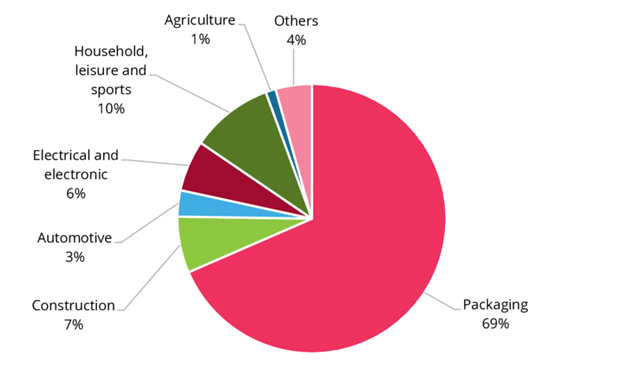
The above pie chart of estimated plastic waste by industrial sector was prepared by Ed Cook, Emma Burlow, Edward Kosior, Bernie Thomas, Brian Riise and John Gysbers in article “Eliminating avoidable plastic waste by 2042: a use-based approach to decision and policy making.” and presented by “Resourcing the Future Partnership Steering Group”. The article was published in collaboration with Reuters 27 Oct 2021 by Adrian PortugalJournalist, Reuters.
Consumer Alert!
My wife and I do a lot of our shopping at our local Safeway grocery stores. They’ve been working hard, as do many grocers these days, in trying to provide products that are sustainable and organic. That said, they recently took a WRONG TURN in the plastic packaging of many of their O Organics product line and it’s up to us to remind them.
Please note the following statement from O Organics, one of Safeway’s premier product lines:
“Why O Organics® ?
With O Organics®, you know that what you feed your family is actually good for them. Because all O Organics® products are USDA Certified Organic. They are made responsibly, sustainably and safely (my highlighting). They are always non-GMO, and grown without synthetic pesticides.
Dear fellow consumers: feeding your family microplastics is NOT good for them and pumping MORE plastics into our environment is NOT helpful. https://www.safeway.com/shop/lp/o-organics-organic.html is the home of O Organics. Please write to them and express your disdain for switching from paper containers to PLASTIC containers in many of their dairy products, e.g. Half and Half, Heavy Whipping Cream, etc. This switch happened just this year (2021)! They also have countless other products that are being sold in plastic that could be packaged in a more sustainable manner. We, as consumers, need to fight back or we will truly be even more awash in plastic.
Safeway is trying to do the right thing by going to a product line like O Organics. We LAUD their efforts to bring us higher quality products. Unfortunately, they’ve become distracted from their mission and it’s up to us to remind them that we DO care about our environment and the products we consume. Please go to https://www.safeway.com/shop/lp/o-organics-organic.html and at the bottom of the page, under Quick Links, click on “Contact Us”. Scroll down to the lower part of the next screen to the header ‘Contact Us’ and the right most of three boxes is a box “Other Ways To Contact Us“. Click on “Comments and Questions” and explain to them that their sustainable practices are going BACKWARDS instead of forwards in their packaging. This page also has addresses for Customer Support Center and Media Inquiries. ANYTHING you can do to help mitigate this senseless INCREASE in plastics will help. Your planet and your body THANK YOU!!!

 worthyvisions.com